AI Slop is a Byproduct of Automated Abundance
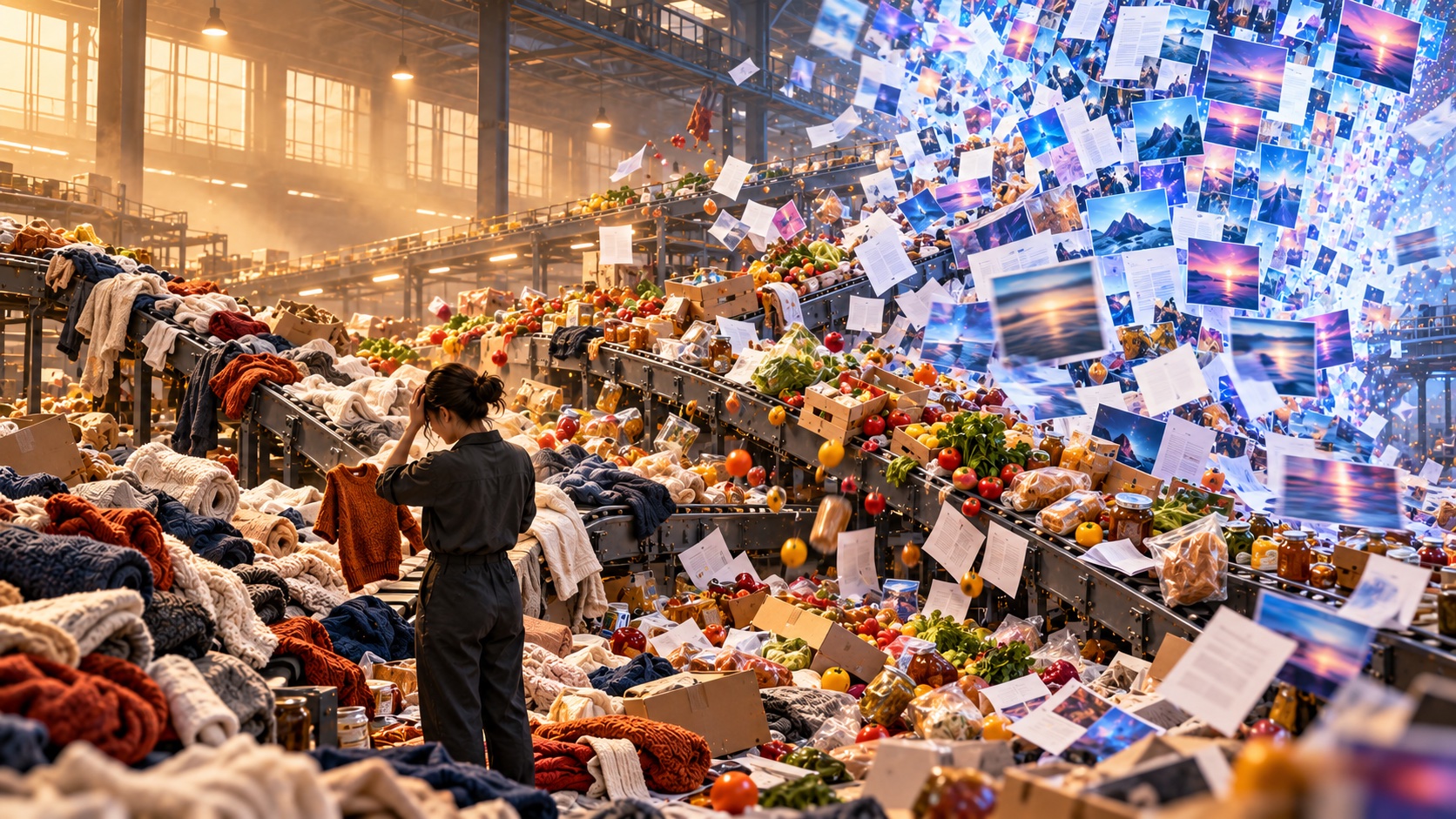
Automation Slop
One of the arguments against AI these days is about the rising levels of AI slop - the poor quality, AI generated code, art, text, video, etc that is incorrect, feels empty and offends our sense of decorum. AI slop seems new, but it is actually the latest chapter in a very old story. In fact, I’d like to propose that we think about AI slop in a much broader context in order to understand the cause of this unwanted excess. You see, automation makes more things available cheaper. Slop appears when producing and distributing them becomes easier than deciding whether they are worth anyone’s time.
Automation slop is a repeating pattern:
- Automation enables a product that required expensive skills to be produced faster and cheaper
- Automation displaces skilled workers who feel the immediate impact
- Higher production volume reduces per unit cost and helps producers make more profit by reaching a larger market
- Supply goes up so consumers have more selection which creates pressure to lower prices
- Even higher volume lowers production cost even more - building is no longer the barrier. Producers are incentivized to build to excess in to order keep per unit prices down and reach more customers
- The market is flooded with excess, low value products that nobody wants to consume - the slop
When automation transforms an industry, often the benefits are substantial, but so is the damage. When production becomes inexpensive enough, producers profit by making and distributing more than people can use or evaluate. AI slop is just the latest in a long line of automation slop. I’ll give you some examples that might help us anticipate what to expect next. Slop is the downside of abundance. I’ll illustrate the pattern with some examples from history.
A personal realization of our modern abundance
My wife and I travelled to the former Eastern Germany shortly after the Berlin wall came down, long before generative AI. Before the reunification of Germany, residents in the eastern block countries were used to shortages. For example, if a store had toilet paper, they bought it. The price was the price. The only consideration was whether or not it was available. With the sudden western influence after the fall of the wall, there were multiple brands of toilet paper to choose from. They had to learn to comparison shop across different features and price points at different stores, not to mention the possibility of a sale for a finite time period at one store. It was fascinating to watch the mental gymnastics they were performing to adapt to their new world of abundance. Soon after we returned home I recall a trip to Safeway where my wife gave me a coupon and asked me to go to find the matching product. I found myself standing in an aisle, staring up at a wall of deodorant of all different brands, scents and styles trying to pattern match to the picture on the coupon. It was overwhelming. I was slightly nauseated by the sheer volume of products marketed to me to help smell acceptable. Do we really need so many deodorants? The AI optimists tell you that AI will bring abundance, but that promise can obscure the fact that we already live in an incredibly abundant world. Let’s talk about how we got here.
Textile slop
Most people who study technological transformation know this story. Mechanized weaving devastated skilled weavers and finishers. The Luddites attacked the new textile machinery in the English textile districts from 1811 to 1816, but were met with violence. The government sent in around 13,000 troops, and 35 people were executed in all. At York in January 1813, George Mellor and sixteen other men were hanged. It was brutal, and just to be clear the resistance wasn’t really about hating machines. It was about determining who benefitted and who suffered as the machines took over production.
The financial gains of mechanized textile production were significant. Economic historian C. Knick Harley estimates that the real price of cotton cloth fell about 80% between the mid-1780s and the late 1820s. Clothing went from a major household expense to something almost anyone could own, and cheap cloth became a pillar of global trade.
Now fast-forward to today. You and I have clothes in our closet that fit us (or at least used to) despite never consulting a tailor because automation has allowed manufacturers to make high volume clothing of all sizes and styles so you can find the item that is right for you. You find the clothes you want in the neighborhood Walmart, Old Navy, Target, Macy’s or any of a hundred other stores. To fill all the clothing racks you browse as well as endless Amazon and online warehouses, it is expected that manufacturers over produce. That is what allows you to select the size and style you want instantly. If a store doesn’t have exactly the garment you want right now, they don’t get your business, so they have to stock much more than they can sell. And the clothes you bought last year? Can’t wear those anymore because each year brings new options. The Ellen MacArthur Foundation reports that in the last 15 years clothing production roughly doubled while clothing use fell almost 40%, with many items discarded after just seven to ten wears. In the US alone, 11.3 million tons of textiles went to landfills in 2018. When making a garment costs almost nothing, it becomes disposable. It is more profitable to make more product than it is to risk producing only what you think will sell and being wrong. Of course, this births a marketing system to convince you to buy more than you need. Each season and year styles change in order to convince you to buy new clothes instead of wearing that old thing from last year. Clothes aren’t built for durability and wear out quickly. Capitalistic forces encourage creating excess. That is textile slop.
Food slop
For most of history, putting food on the table consumed most of a family’s labor. In 1790 about 9 in every 10 people lived on farms. By 1900 37.9% of the labor force and 15.5% of GDP. By 2017 it was 1.1% of the labor force and 0.9% of GDP, and USDA puts farms at about 0.8% of GDP in 2023. As tractors and harvesting machines became ubiquitous, productivity increased. USDA estimates that U.S. farm output per hour worked rose 17-fold from 1948 to 2017. Total output nearly tripled while farm labor hours fell 83%. These days farmers aren’t necessarily people who have their hands in the soil. Instead, they command fleets of robotic, autonomous tractors that disperse computer controlled, GPS localized fertilizer and computer vision guided weed killer.
Being able to feed the masses is one of the greatest achievements of automation. Hunger is now limited by logistics and economic will, not production. Automation removed a huge number of constraints that once limited food production. This amazing capability also brought some down sides with it. Cheap calorie production came with industrial-scale food waste. The USDA estimates that 30-40% of the US food supply is wasted. Additionally, in creating a system that can miraculously feed us all, we have created an epidemic of obesity that contributes to over 15% of deaths in the US. All this in order to produce so much food that we can throw it away. That is food slop.
The Abundance Trap
The pattern is repeating now but in a different form. We already live in a world of disposable products produced by automation that make it easier to just buy a new one than repair the old one. Now we are automating intelligence itself. Analysis, writing, code, design and advice are heading toward a marginal cost close to zero, which implies an oncoming overabundance of “intelligence” and “thinking.” I personally believe that a lot of this output will be positive. Expertise that was once expensive, like tutoring, a second opinion, a draft of a contract or scientific discovery, will be available to almost anyone, even more so than cheap cloth and cheap calories have become. Unlike textiles and food, the natural resources required for intelligence can be even less expensive. AI ideas are generated with electrons. Despite the rising concern about AI’s appetite for water and electricity, it costs much less to have Suno generate a song, create visual art with Midjourney, or compose a spam email than it does to grow a squash or fabricate a shirt. As a result we need to expect an abundance of AI slop. Based on history, I expect capitalism to encourage over production and let the market sort it out. The burden of culling falls increasingly on the consumer. Now instead of choosing from racks and racks of clothing we will have to sort through much higher volumes of content, ideas, and influence mixed into our daily lives. For every life saving drug that is created by AI, there are likely to be millions of pieces of slop for us to sort through. Add to this slop AI agents that take slop actions and you will have a wave of everything from spam to cyber attacks to misguided agents that perform unwanted and sometimes dangerous tasks.
Capitalism will steer automated abundance the same way it has throughout history:
- Volume wins over quality. When thinking is cheap and undifferentiated, the way to win is to produce more of it, faster.
- Attention will be the scarce resource. Fast fashion is created to be bought, not worn. Ultra-processed food is made to be eaten, not to nourish you. Therefore we should expect content engineered to be consumed, not to inform. We have seen this for years in social media, but now it will be much higher volume.
- It is up to us to sort the waste. Textile waste ends up in landfills and food waste in the same place. The landfill for thought is our attention, our trust and our shared sense of what is true.
- Skills will be repriced. As with weavers and farmers, the people whose skills are automated will be the first to feel the cost. The big difference this time is the number of people that will be affected as much more general skills are displaced.
Add to this the fact that this new automation is being put into everyone’s hands. Instead of just a few business owners controlling the looms, billions of people now have access to this new automated means of production. We should expect slop at unprecedented levels. This is the dark side of abundance, and despite how early we are, you already see it in reports nobody reads, summaries of summaries, news stories that just don’t make sense, plausible answers that are just wrong, and code nobody fully understands. On top of this, robots are coming right behind AI and who knows what type of unwanted slop and excess they will create.
We’ve made it through this before
The good news is that there will also be transformative positive output from this automation. Even though I see difficult times ahead, I know that we will develop ways of coping with it. Humans are incredibly adaptive and resilient. Despite all the issues, I think that very few people who live in this future would trade it to come back to our present day. I do hope that we can also steer AI to help us sort through the slop.
In the mean time, what can we do to prepare? If production becomes nearly free, value will move to what the machines can’t supply: verification, provenance, taste, judgment and accountability. These are the skills that will be valuable going forward. Before forwarding or acting on AI output, individuals must use their judgement. Companies and individuals must remain responsible for the actions of their agents. Just because we have artificial intelligence doesn’t mean we should stop using our own. Cloth and food eventually established premium niches for craft and quality, and they also developed rules about safety and labor. Similarly, I think that the combination of artificial intelligence with human judgement and accountability can be stronger than either alone.
This time we can anticipate what is coming. The lesson is not to stop the machines. It is to decide early what we will not throw away, and to look after the people whose skills get devalued along the way. Get ready for your judgement skills to become more valuable and to be put to the test.
How are you adjusting to the new abundance?
Thank you for reading this far. As a reward and because I enjoy certain kinds of irony, here is a bit of Automation Slop that I produced just for this post.

Comments